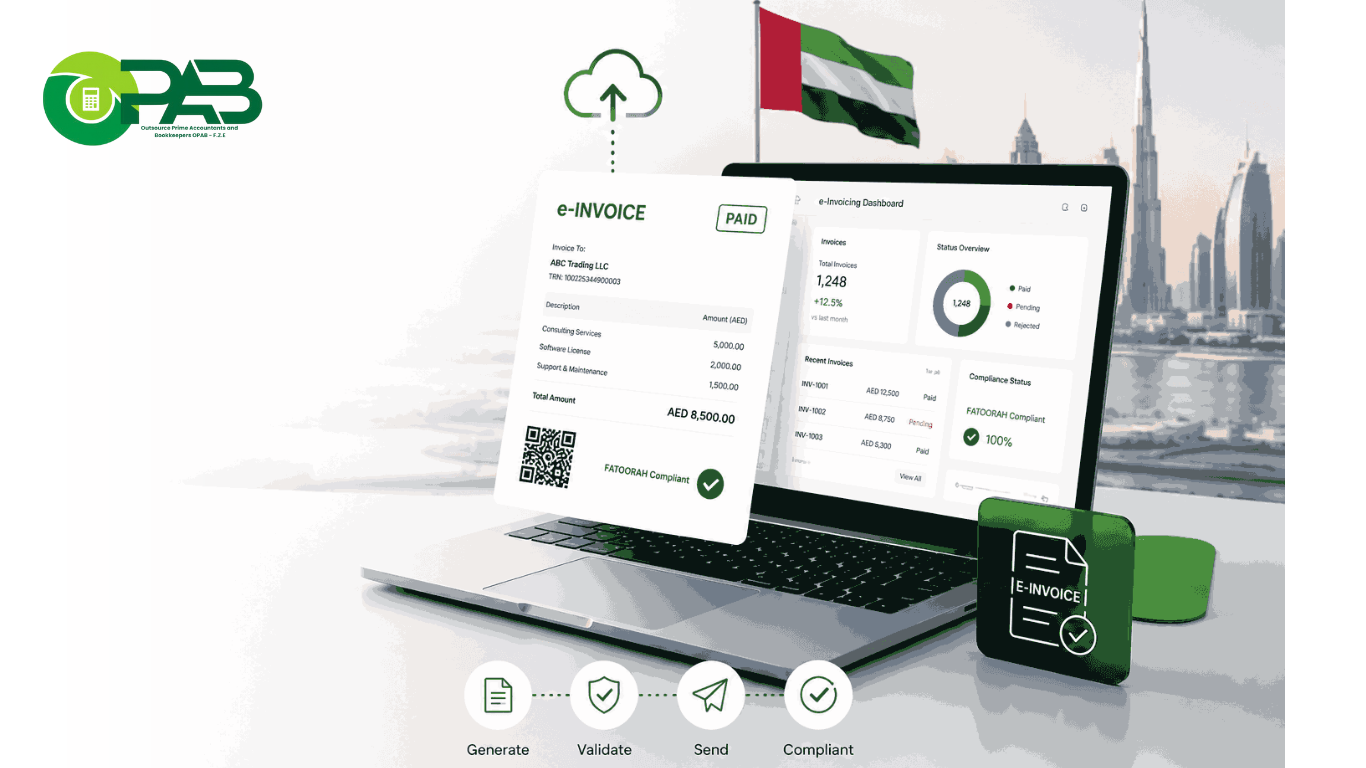
UAE E-Invoicing: Beyond Regulatory Compliance
The introduction of UAE e-invoicing represents a major milestone in the country’s digital tax transformation.
While many businesses see electronic invoicing as another regulatory obligation, forward-thinking business owners and CFOs recognize a much bigger opportunity.
Beyond compliance, UAE e-invoicing can help businesses reduce operating costs, improve cash flow visibility, strengthen financial controls, and accelerate digital transformation.
The real question is not simply how businesses can comply, but how they can turn this mandatory change into a competitive advantage.
What Is UAE E-Invoicing?
UAE e-invoicing is a government initiative that enables businesses to exchange invoice information electronically using structured, machine-readable formats.
Unlike traditional PDF invoices, structured electronic invoices support automated processing, standardized data exchange, and improved transaction transparency.
The UAE framework uses accredited service providers to facilitate the exchange and reporting of electronic invoice information.
Its key objectives include:
Improving VAT compliance and tax transparency.
Reducing manual invoice processing and errors.
Standardizing financial transaction data.
Supporting business efficiency and digital transformation.
For businesses, this requires more than a software upgrade. It creates an opportunity to rethink how financial transactions are managed.
UAE E-Invoicing Implementation Deadlines
The UAE has adopted a phased implementation approach.
| Business Category | Mandatory Implementation |
|---|---|
| Businesses with annual revenue of AED 50 million or more | 1 January 2027 |
| Businesses with annual revenue below AED 50 million | 1 July 2027 |
| In-scope government entities | 1 October 2027 |
Businesses should also note the applicable deadlines for appointing an Accredited Service Provider (ASP).
Larger businesses must appoint their ASP by 30 October 2026, while smaller businesses and in-scope government entities have a deadline of 31 March 2027.
Implementation requirements depend on the applicable regulations, business classification, and transaction scope.
Businesses should verify their obligations through the UAE Ministry of Finance and Federal Tax Authority.
5 Strategic Opportunities of UAE E-Invoicing
1. Reduce Costs Through Finance Automation
Traditional invoicing involves manual data entry, document verification, approvals, and reconciliation.
These activities increase administrative costs and expose businesses to processing errors.
E-invoicing enables businesses to automate repetitive accounting activities and improve operational efficiency.
Potential benefits include lower processing costs, fewer invoice errors, faster reconciliation, and reduced administrative workloads.
CFO perspective: Automation should allow finance teams to spend less time processing transactions and more time supporting financial planning and business decisions.
2. Improve Cash Flow and Working Capital
Efficient invoicing is essential for effective cash flow management.
Delayed invoice issuance, billing errors, and slow approvals can negatively affect collections.
UAE e-invoicing can help businesses improve invoice delivery, monitor outstanding receivables, and reduce avoidable processing delays.
When integrated with accounting systems, it can provide better visibility over accounts receivable and customer payment patterns.
Although electronic invoicing does not automatically accelerate payments, it creates a stronger foundation for effective collections and working capital management.
3. Strengthen VAT Compliance and Financial Controls
Manual invoicing increases the risk of incorrect VAT treatment, missing information, and inconsistent financial records.
Structured electronic invoicing can improve data accuracy, transaction traceability, and reconciliation.
Businesses should use implementation as an opportunity to review VAT codes, customer information, invoice controls, and accounting procedures.
However, technology does not replace professional tax judgment. Businesses remain responsible for applying the correct VAT treatment.
Strategic benefit: Stronger financial controls can reduce compliance risks while improving the reliability of management reporting.
4. Accelerate Digital Transformation
Many businesses operate accounting software alongside spreadsheets, email approvals, and disconnected applications.
UAE e-invoicing provides an opportunity to modernize these processes.
Integrating electronic invoicing with ERP, procurement, inventory, and financial reporting systems can reduce duplication and improve data consistency.
Rather than implementing a standalone compliance solution, businesses should build an integrated finance environment that supports long-term growth.
5. Improve Financial Reporting and Decision-Making
Reliable financial information is essential for effective business decisions.
E-invoicing can support more consistent transaction data, helping management monitor:
Days Sales Outstanding (DSO).
Invoice processing costs.
Accounts receivable aging.
Invoice error rates.
VAT reconciliation differences.
Better information allows CFOs to identify inefficiencies, monitor financial performance, and make more informed decisions.
The long-term value lies in transforming transaction data into meaningful financial insights.
What Is the Financial ROI of UAE E-Invoicing?
E-invoicing should be evaluated as a financial investment, not merely a compliance expense.
Consider a hypothetical business processing 5,000 invoices monthly.
| Financial Metric | Amount |
|---|---|
| Monthly invoices | 5,000 |
| Current processing cost per invoice | AED 12 |
| Automated processing cost per invoice | AED 5 |
| Savings per invoice | AED 7 |
| Potential annual gross savings | AED 420,000 |
This illustrative example demonstrates the potential value of automation.
Actual savings depend on transaction volumes, existing processes, software costs, integration expenses, and ongoing service provider fees.
CFOs should evaluate both implementation costs and measurable operational benefits when calculating return on investment.
How Businesses Should Prepare for UAE E-Invoicing
Successful implementation requires a coordinated approach involving finance, accounting, IT, procurement, and management.
Businesses should prioritize five actions:
Assess readiness: Review existing invoicing processes, accounting systems, and VAT controls.
Confirm compliance requirements: Identify applicable deadlines, transaction scope, and technical obligations.
Evaluate technology: Assess ERP integration capabilities and select an appropriate accredited service provider.
Improve data quality: Review customer records, supplier information, and transaction classifications.
Measure performance: Establish KPIs for invoice processing costs, error rates, reconciliation, and cash flow.
The objective should be to achieve regulatory compliance while creating a more efficient and scalable finance function.
Frequently Asked Questions
Is e-invoicing mandatory in the UAE?
Yes. The UAE has established a phased mandatory e-invoicing framework for covered businesses and transactions, with implementation beginning in 2027.
Are PDF invoices acceptable under UAE e-invoicing?
A conventional PDF invoice sent by email does not, by itself, meet the structured electronic invoice requirements.
Will businesses need new accounting software?
Not necessarily. Existing accounting systems may be suitable if they can integrate with an accredited service provider and meet the applicable technical requirements.
How does e-invoicing benefit small businesses?
Potential benefits include reduced administrative work, improved billing accuracy, stronger VAT controls, and better visibility over receivables.
Conclusion: From Compliance Cost to Strategic Investment
UAE e-invoicing is more than a regulatory requirement. It represents an opportunity for businesses to modernize financial operations, strengthen controls, and improve efficiency.
Businesses that approach implementation strategically can potentially achieve lower operating costs, better financial visibility, and a more scalable finance function.
For CFOs and business owners, the key is to look beyond the compliance deadline and focus on long-term business value.
The businesses that benefit most from UAE e-invoicing will not simply be those that comply on time, but those that use the transition to build smarter, more efficient, and financially stronger organizations.
Is Your Business Ready for UAE E-Invoicing?
Start with an e-invoicing readiness assessment to identify compliance gaps, technology requirements, implementation costs, and opportunities for finance automation.
Turn mandatory compliance into measurable business value. Contact OPAB to book your FREE consultation!
Official References:
Disclaimer: This article provides general business information. Companies should verify applicable e-invoicing requirements and deadlines against the latest UAE regulations and official guidance.