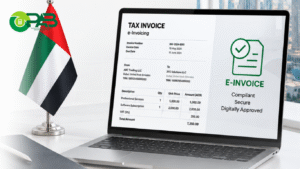
Introduction: Is Your Accounting Software Ready for UAE E-Invoicing?
The UAE is introducing mandatory electronic invoicing, bringing significant changes to how businesses issue, receive, and process invoices.
For companies using QuickBooks, Xero, Zoho Books, SAP, Oracle, or other ERP systems, one important question arises:
Is your accounting software ready for UAE e-invoicing requirements?
Many businesses already generate PDF invoices and send them by email. However, under the UAE’s new framework, electronic invoicing requires structured, machine-readable data transmitted through Accredited Service Providers (ASPs).
This means traditional PDF invoicing alone will not satisfy the requirements for transactions subject to mandatory e-invoicing.
The good news? Businesses may not need to replace their accounting software. In many cases, upgrades or system integrations could provide the required functionality.
1. Why Accounting Software Readiness Matters
UAE e-invoicing is not simply about creating digital invoices. It requires accounting systems to support standardized invoice information and electronic transmission.
An e-invoicing-ready accounting system should be capable of:
Generating structured invoice data.
Capturing mandatory customer, supplier, and VAT details.
Connecting with an Accredited Service Provider.
Sending and receiving electronic invoices.
Identifying invoice errors and rejections.
Processing electronic credit notes.
Maintaining appropriate audit trails.
These functions may be provided directly by the accounting system or through integrated solutions.
CFO Insight: E-invoicing readiness involves your entire invoicing process, not just your accounting software.
2. Required Invoice Data and Formats
One of the biggest changes under UAE e-invoicing is the shift from PDF invoices to structured electronic data.
PDF vs. structured e-invoices
PDF invoice | Structured e-invoice |
|---|---|
Designed for human reading | Designed for machine processing |
Usually sent by email | Exchanged through the prescribed network |
May require manual entry | Supports automated processing |
Flexible document layout | Standardized data format |
Often manually validated | Supports automated validation |
The UAE’s framework uses Peppol-based standards, including the applicable PINT AE specifications.
What information is required?
Depending on the transaction, invoice data may include:
Supplier and customer identification details
Invoice number and date
Goods or services description
Quantities, prices, and discounts
VAT categories, rates, and amounts
Currency and invoice totals
Credit note references, where applicable
Businesses should review their existing invoice templates and customer records to ensure the required information is available.
Important: Even compatible software can experience invoice rejections if customer details, VAT codes, or mandatory fields are incorrect.
3. Integration with Accredited Service Providers
Under the UAE’s five-corner e-invoicing model, businesses exchange structured invoices through Accredited Service Providers.
The process generally works as follows:
Supplier Accounting / ERP System
Generates invoice information
Supplier Accredited Service Provider
Validates and transmits invoice data
Customer Accredited Service Provider
Receives the structured invoice
Customer Accounting / ERP System
Processes the invoice
Prescribed tax-data reporting to the FTA is also part of the framework
Do you need new accounting software?
Not necessarily. Businesses generally have three options:
1. Built-in e-invoicing functionality: Use UAE-compatible features provided by the existing software vendor.
2. Third-party integration: Connect the current accounting system to an ASP through an API or middleware.
3. ERP upgrade: Customize or upgrade the system to support required invoice data and electronic transmission.
The best option depends on transaction volume, system capabilities, and implementation costs.
4. Questions to Ask Your Accounting Software Provider
Before assuming your software is compliant, ask your vendor these important questions.
Question | Why it matters |
|---|---|
Does your software support UAE e-invoicing? | Confirms UAE-specific readiness |
Can it support PINT AE requirements? | Establishes technical compatibility |
Which ASPs can it integrate with? | Identifies connectivity options |
Can it send and receive structured invoices? | Covers sales and purchases |
Are upgrades or additional modules required? | Identifies extra costs |
How are rejected invoices handled? | Supports error correction |
Does it support electronic credit notes? | Handles invoice adjustments |
What is the implementation timeline? | Helps prevent delays |
Remember: Software advertised as “e-invoicing ready” does not automatically mean your business is fully compliant. Proper configuration, data accuracy, integration, and testing are still essential.
5. UAE E-Invoicing Implementation Timeline
The UAE Ministry of Finance has established a phased implementation schedule.
Business category | ASP appointment deadline | Mandatory implementation |
|---|---|---|
Annual revenue of AED 50 million or more | 30 October 2026 | 1 January 2027 |
Annual revenue below AED 50 million | 31 March 2027 | 1 July 2027 |
In-scope government entities | 31 March 2027 | 1 October 2027 |
The framework generally applies to in-scope business-to-business (B2B) and business-to-government (B2G) transactions, subject to exclusions.
Businesses should confirm their applicable deadlines and begin preparations before mandatory implementation.
6. UAE E-Invoicing Readiness Checklist
Use this checklist to assess your business’s current preparation.
Business readiness 0/8 completed
_________________________________________________
If several items remain incomplete, your business should prioritize an e-invoicing readiness assessment.
7. Benefits Beyond Compliance
UAE e-invoicing also creates opportunities to improve financial operations.
Faster Accounts Receivable: More efficient invoice transmission can reduce processing delays and help improve collections.
Automated Accounts Payable: Structured supplier invoices can reduce manual data entry and support invoice matching.
Improved VAT Controls: Standardized invoice information can support more accurate tax validation and reconciliation.
Better Cash Flow Visibility: Integrated invoice data helps finance teams monitor outstanding receivables and upcoming payments.
Lower Administrative Costs: Automation can reduce repetitive tasks, errors, and invoice processing time.
For CFOs and business owners, the objective should be to use e-invoicing as an opportunity to strengthen the overall finance function.
Frequently Asked Questions
Is QuickBooks, Xero, Zoho, SAP, or Oracle compliant with UAE e-invoicing?
Compliance depends on the specific software version, configuration, UAE functionality, and ASP integration. Businesses should obtain confirmation directly from their software providers.
Can businesses continue using PDF invoices?
PDFs may still be used for reference, but they do not replace structured electronic invoices for transactions covered by mandatory UAE e-invoicing.
Does e-invoicing replace UAE VAT returns?
No. Businesses must continue meeting applicable VAT return filing, payment, and recordkeeping obligations.
Do businesses need an Accredited Service Provider?
Yes, businesses subject to the framework must use the prescribed accredited service provider arrangements.
Conclusion: Prepare Your Accounting System Before the Deadline
UAE e-invoicing represents a major shift in how businesses manage invoices and financial information.
The transition requires more than software compatibility. Businesses must ensure their invoice data, accounting processes, service provider integration, and internal controls are ready.
Preparing early can help businesses avoid compliance issues, reduce operational disruptions, and unlock the benefits of finance automation.
Get Your Business E-Invoicing Ready with OPAB
Is your accounting software ready for UAE e-invoicing?
OPAB can help you assess your accounting processes, identify potential compliance gaps, and prepare your business for the transition.
Book your FREE consultation with OPAB today!
Get practical accounting and compliance guidance to support a smoother transition.
OPAB | Your Partner in Smarter Business Finance
Official References
Regulatory information as of October 2026. Businesses should confirm current technical requirements and implementation deadlines with the UAE Ministry of Finance and Federal Tax Authority.