Introduction
The way businesses issue and manage invoices in the United Arab Emirates is changing.
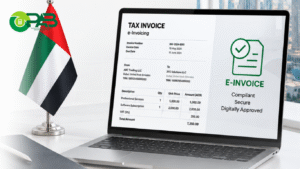
With the introduction of UAE e-invoicing, companies will transition toward a standardized digital invoicing system designed to improve tax compliance, reduce errors, and streamline financial transactions.
The UAE began its e-invoicing pilot phase on 1 July 2026, with mandatory implementation starting in January 2027.
Whether you operate a small business, consultancy, trading company, or large corporation, understanding these requirements now can help you avoid compliance issues and unnecessary costs.
1. What Is UAE E-Invoicing?
UAE e-invoicing is a government initiative requiring businesses within scope to issue, exchange, and report invoices electronically using a structured digital format.
Unlike traditional invoicing, the new system allows invoice data to be processed automatically between compatible accounting systems.
Important: Sending an invoice as a PDF through email does not qualify as compliant e-invoicing.
The UAE is adopting a decentralized five-corner model using the Peppol framework, with Accredited Service Providers (ASPs) facilitating electronic invoice exchange and tax-data reporting.
For businesses, this means existing accounting software may require upgrades or integration with an approved provider.
2. Who Will Be Affected?
UAE e-invoicing primarily applies to relevant:
Business-to-Business (B2B): Transactions between businesses.
Business-to-Government (B2G): Transactions involving government entities.
Both mainland and free zone businesses should assess their obligations.
Importantly, small businesses are not automatically exempt, even if their annual revenue is below AED 50 million.
Business-to-Consumer (B2C) transactions are currently excluded from mandatory implementation until further regulatory decisions.
VAT registration status alone does not determine whether a business must comply.
3. UAE E-Invoicing Implementation Timeline
The UAE Ministry of Finance has introduced a phased implementation schedule.
Key Date | Requirement |
|---|---|
1 July 2026 | Pilot and voluntary implementation began |
30 October 2026 | Businesses with revenue of AED 50M+ must appoint an ASP |
1 January 2027 | Mandatory e-invoicing for businesses with revenue of AED 50M+ |
31 March 2027 | Businesses below AED 50M and government entities must appoint an ASP |
1 July 2027 | Mandatory e-invoicing for in-scope businesses below AED 50M |
1 October 2027 | Mandatory implementation for government entities |
Important update: The ASP appointment deadline for businesses with annual revenue of AED 50 million or more was extended to 30 October 2026.
Businesses should monitor official announcements for further updates.
4. Why Is the UAE Introducing E-Invoicing?
The initiative supports the UAE’s digital transformation and aims to improve business efficiency and tax compliance.
Key benefits include:
Better VAT compliance: More accurate and standardized tax information.
Reduced manual work: Less paperwork and repetitive data entry.
Fewer invoicing errors: Improved accuracy through automated processes.
Better financial visibility: Easier monitoring of invoices and receivables.
Improved cash flow management: More efficient invoice processing may reduce billing delays.
For business owners, e-invoicing is not just about meeting regulatory requirements. It also creates opportunities to strengthen financial controls and accounting processes.
5. What Should UAE Businesses Start Doing Now?
Waiting until the deadline could result in rushed implementation, additional expenses, and operational disruptions.
Here are six practical steps to prepare:
1. Assess your compliance requirements
Determine your annual revenue, transaction types, and applicable implementation deadline.
2. Review your accounting software
Check whether your current accounting or ERP system supports UAE-compliant e-invoicing or requires integration.
3. Select an Accredited Service Provider
Compare approved providers based on pricing, software compatibility, technical support, and implementation requirements.
4. Review your invoice data
Ensure customer information, supplier records, VAT details, and invoice fields are accurate and complete.
5. Train your finance team
Prepare employees to issue, receive, correct, and reconcile electronic invoices.
6. Establish an implementation plan
Assign responsibilities, estimate costs, and allow sufficient time for system testing and onboarding.
CFO Tip: Treat e-invoicing as a financial systems improvement project, not simply another tax compliance task.
6. What Happens If Your Business Is Not Ready?
Failure to comply with applicable UAE e-invoicing requirements may expose businesses to administrative penalties and operational difficulties.
Potential risks include:
Penalties for specific regulatory violations.
Delays in issuing and processing invoices.
Disruptions to customer and supplier transactions.
Additional costs for urgent software upgrades.
Errors in VAT-related records.
The UAE has established an administrative penalty framework under Cabinet Decision No. 106 of 2025.
However, the financial impact of delayed invoicing and collections could be just as significant as regulatory penalties.
7. Is E-Invoicing an Additional Cost or an Opportunity?
Businesses may initially face expenses for software upgrades, ASP fees, integration, and staff training.
However, automating invoice processing can reduce administrative work and improve financial reporting.
For example, a company processing hundreds of invoices monthly may save considerable employee time by reducing manual data entry and reconciliation.
This allows finance teams to focus more on cash flow forecasting, collections, and business planning.
From a CFO’s perspective, e-invoicing should be viewed as an investment in stronger financial controls and operational efficiency, not just a compliance expense.
8. Frequently Asked Questions
Is UAE e-invoicing mandatory?
Yes. Mandatory implementation begins on 1 January 2027 for businesses within the first implementation phase.
When must SMEs comply?
In-scope businesses with annual revenue below AED 50 million must implement e-invoicing by 1 July 2027.
Can businesses continue using PDF invoices?
PDF invoices alone will not satisfy the structured electronic invoicing requirements.
Does e-invoicing replace VAT returns?
No. Businesses must continue meeting their existing VAT filing obligations.
Do I need new accounting software?
Not necessarily. Your existing system may support integration with an Accredited Service Provider.
9. Final Thoughts: Prepare Your Business Now
UAE e-invoicing represents an important change in how businesses manage invoicing, accounting, and tax compliance.
Although mandatory implementation begins in 2027, businesses should start preparing today.
Review your accounting systems, understand your obligations, select a suitable service provider, and train your team.
Early preparation can help your business avoid compliance risks, control implementation costs, and improve financial efficiency.
Is Your Business Ready for UAE E-Invoicing?
Don’t wait until the mandatory deadline to prepare your business.
Ensure your accounting systems, invoicing processes, and tax compliance requirements are ready for the transition.
Contact OPAB today to book your FREE consultation!
Our team can help you understand the UAE e-invoicing requirements, identify potential compliance gaps, and prepare your business for a smooth transition.
Stay compliant. Avoid costly mistakes. Get your business e-invoicing ready with OPAb.
Official References
UAE Ministry of Finance – E-Invoicing
UAE Federal Tax Authority
UAE Ministry of Finance – Official Website
Disclaimer: This article provides general information based on UAE e-invoicing guidance as of October 2026. Businesses should verify their specific obligations and monitor official regulatory updates.