Introduction
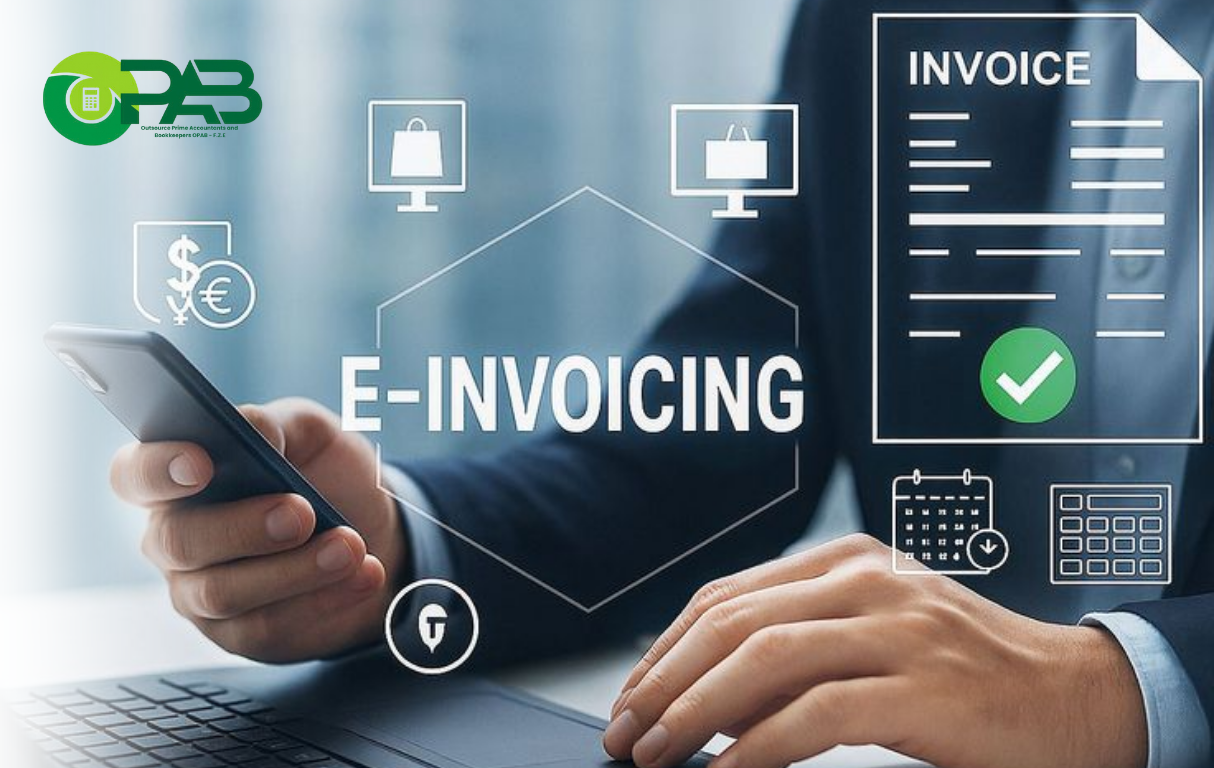
The UAE is moving toward a more digital approach to invoicing and financial reporting. For small and medium-sized enterprises (SMEs), e-invoicing will change more than just how invoices are created and sent. It will also affect bookkeeping, accounting workflows, reconciliation, record-keeping, and tax compliance.
For UAE SMEs, this transition presents an opportunity to review existing accounting processes and reduce reliance on manual work before mandatory implementation begins.
What Is E-Invoicing in the UAE?
An electronic invoice, or eInvoice, is not simply a PDF invoice sent by email.
According to the UAE Ministry of Finance, an eInvoice is structured invoice data that is issued and exchanged electronically between a supplier and buyer and reported electronically to the UAE Federal Tax Authority. PDF files, Word documents, scanned invoices, images, and ordinary emails do not by themselves qualify as eInvoices under the framework.
The UAE’s system uses the OpenPeppol standard, providing a standardized method for businesses and government entities to exchange electronic invoice information.
This means businesses should think beyond simply replacing paper invoices with digital documents. The larger change is the movement toward structured, system-to-system financial data.
When Will UAE SMEs Need to Implement E-Invoicing?
The UAE’s eInvoicing rollout is being implemented in phases.
For businesses with annual revenue below AED 50 million, the current implementation schedule requires an Accredited Service Provider (ASP) to be appointed by 31 March 2027, with mandatory eInvoicing implementation from 1 July 2027.
Businesses should also be aware that the scope and implementation requirements depend on the applicable UAE eInvoicing rules and exclusions. For example, the current framework does not yet subject business-to-consumer (B2C) transactions to mandatory eInvoicing.
For the latest official requirements, businesses should monitor the UAE Ministry of Finance eInvoicing portal.
How E-Invoicing Could Change Accounting for UAE SMEs
1. Less Manual Data Entry
Many SMEs still rely on a combination of accounting software, spreadsheets, PDF invoices, emails, and manual encoding.
Every time financial information has to be entered manually, there is a possibility of duplication, incorrect amounts, missing information, or classification errors.
Structured eInvoice data can reduce some of this manual processing by allowing invoice information to move electronically between systems.
The result could be a more efficient accounts payable and accounts receivable process, particularly for businesses processing a significant number of invoices each month.
2. Faster and More Accurate Reconciliation
Reconciliation is one of the most important bookkeeping controls for any SME.
Businesses regularly need to match invoices against customer balances, supplier accounts, payments, bank transactions, and accounting records.
When invoice information is standardized and available electronically, businesses may be able to automate more of the matching process.
Instead of spending significant time identifying invoices manually, accounting teams can focus more attention on exceptions—such as unpaid invoices, duplicate transactions, incorrect amounts, or payments that cannot be matched.
3. More Consistent Financial and Tax Reporting
Good financial reporting depends on good underlying data.
If invoices are incomplete, incorrectly recorded, or entered late, management reports may not accurately reflect the company’s financial position.
Structured eInvoicing can help improve the consistency of transaction data and potentially reduce errors in financial and tax reporting. The UAE Ministry of Finance has specifically highlighted improved process efficiency, reduced errors, and more accurate data for tax reporting among the practical benefits of the system.
For SMEs, better-quality accounting data can also improve internal reports such as profit and loss statements, accounts receivable ageing, accounts payable ageing, cash-flow reports, and management accounts.
4. Stronger Digital Audit Trails
Another important benefit is the potential for a clearer digital audit trail.
When invoices and accounting information are handled electronically, businesses can maintain more structured records connecting a transaction from invoicing through accounting and payment.
This can make it easier for management, accountants, auditors, and tax professionals to review transactions and investigate discrepancies.
However, technology alone does not create a good audit trail. Businesses will still need appropriate accounting controls, supporting documents, reconciliations, approval procedures, and record-retention practices.
5. Accounting Systems Will Become More Important
For some UAE SMEs, eInvoicing may expose weaknesses in their existing accounting setup.
A business may discover that its customer records are incomplete, supplier information is inconsistent, invoices are not properly classified, or accounting software does not integrate efficiently with other systems.
Businesses should therefore treat eInvoicing preparation as an opportunity to review their overall accounting infrastructure, rather than waiting until the compliance deadline approaches.
The Ministry of Finance has encouraged businesses to plan ahead, including making necessary changes to their internal enterprise solutions so they are compatible with UAE eInvoicing requirements.
Does E-Invoicing Mean SMEs Will No Longer Need Bookkeepers?
No. Automation changes bookkeeping; it does not eliminate the need for accounting expertise.
Software can process structured information quickly, but accounting involves more than transferring numbers from an invoice into a system.
Businesses still need accounting professionals to review unusual transactions, reconcile bank and ledger balances, monitor receivables and payables, correct classification errors, maintain proper accounting records, support VAT and Corporate Tax compliance, and explain financial results to management.
In practice, eInvoicing may allow accountants and bookkeepers to spend less time entering data and more time reviewing, controlling, and interpreting it.
How UAE SMEs Can Prepare for E-Invoicing
SMEs do not need to wait until their mandatory implementation date to begin preparing. A sensible starting point is to review the business’s current invoicing and accounting process.
Management should identify how invoices are currently created, approved, sent, received, recorded, reconciled, and stored. Businesses can then review the quality of customer and supplier master data, assess their accounting software, identify repetitive manual processes, and discuss integration requirements with their accounting provider and Accredited Service Provider.
This preparation can uncover accounting issues that should be corrected regardless of eInvoicing.
E-Invoicing Is More Than a Compliance Requirement
For UAE SMEs, eInvoicing should not be viewed simply as another administrative obligation.
It is an opportunity to modernize the entire invoice-to-accounting process.
Businesses that prepare properly may benefit from less manual data entry, more efficient reconciliation, stronger accounting records, better financial reporting, and improved visibility over their finances.
The technology may automate how information moves—but the quality of a company’s accounting will still depend on accurate records, appropriate controls, regular reconciliation, and professional financial oversight.
How OPAB Can Help UAE SMEs Prepare
Preparing for UAE eInvoicing is also an opportunity to strengthen the accounting processes behind your invoices.
OPAB can help UAE SMEs review and improve their bookkeeping and accounting workflows, clean up financial records, strengthen reconciliation procedures, and prepare their accounting processes for a more digital financial environment.
Whether your business currently relies heavily on spreadsheets and manual bookkeeping or already uses accounting software, establishing clean and reliable financial records now can make the transition to eInvoicing significantly smoother.
Need help getting your books ready for UAE eInvoicing? Contact OPAB to discuss how we can support your bookkeeping and accounting requirements.